Is Wilmington, NC or Savannah, GA the better place to live? Both are historic port cities near the beach, so it mostly comes down to cost and taxes. In the three months ending August 2026, Savannah’s median sale price was about $331,600, compared with about $469,700 in Wilmington. Savannah is cheaper to buy into. Wilmington has a lower income tax rate and a lower headline property tax rate.
I’m Tabi, a REALTOR® with Coldwell Banker Sea Coast Advantage in Wilmington. Savannah comes up a lot with buyers who love Southern coastal cities and are deciding where to land. The two are roughly 300 miles apart, about five hours by car, and they share a lot: historic riverfront downtowns, live oaks and Spanish moss, busy ports, nearby beaches and hurricane seasons. Where they differ is price, state and local taxes, and how each city is growing. Here’s how they compare using current numbers.
The quick comparison
- Median sale price (Redfin, 3 months ending August 2026): about $331,600 in Savannah (down 3.1% year over year) vs. about $469,700 in Wilmington (up 3.2%).
- Typical days on market (same period): 72 in Savannah vs. 56 in Wilmington.
- State income tax (2026): 4.99% flat in Georgia vs. 3.99% flat in North Carolina.
- Property tax: Georgia taxes homes on 40% of market value, and Savannah’s combined rate works out to roughly $1.62 per $100 of market value before exemptions. Wilmington’s combined rate is about 63.75 cents per $100 of full value. Homestead exemptions can lower Savannah bills for primary homes.
- Sales tax: 7% in Chatham County vs. 7% in New Hanover County.
- Average apartment rent (RentCafe): about $1,704 a month in Savannah (August 2026) vs. about $1,675 in Wilmington (September 2026).
- Unemployment (July 2026): 2.7% in the Savannah metro (Georgia Department of Labor) vs. 3.6% in the Wilmington metro (BLS via FRED).
Home prices: Savannah costs less to buy into
This is the biggest difference. Redfin’s city median for Savannah was about $331,600 in the three months ending August 2026, down 3.1% from a year earlier. Wilmington’s was about $469,700, up 3.2%. That’s a gap of roughly $138,000.
Savannah homes are also taking longer to sell, with a median of 72 days on market versus 56 in Wilmington. Redfin rated Savannah “somewhat competitive.”
These are city-limit medians. Both metros include areas that cost more and less than the city number, including islands and newer suburbs. Around Wilmington, buyers often compare the city with Leland across the river, and my Leland vs. Wilmington comparison walks through that choice.
Taxes: different systems, so compare carefully
Income tax. Georgia cut its flat income tax rate to 4.99% for 2026, with plans to keep stepping it down over time (Governor’s office, May 2026). North Carolina’s flat rate is 3.99% for 2026. Georgia also has a retirement income exclusion, currently up to $35,000 per person at ages 62 to 64 and up to $65,000 at 65 and older, set to rise to $70,000 in 2027. If retirement income is part of your plan, talk with a tax professional about how each state would treat it.
Property tax. Georgia taxes homes on 40% of fair market value, and rates are set in mills. Inside Savannah city limits, the county, transit, school and city rates adopted for 2025 add up to about 40.5 mills. On 40% of value, that’s roughly $1.62 per $100 of market value before exemptions. Wilmington’s combined county and city rate is about 63.75 cents per $100 of full value.
Exemptions matter a lot in Savannah. Chatham County’s Stephens-Day homestead exemption freezes the taxable value of an owner-occupied home at its base year or purchase year, with limited adjustments, so long-time owners often pay far less than the headline rate suggests. Georgia also passed new homestead laws in 2025 and 2026 that are still being phased in. Ask for a tax estimate on the specific home, and check how exemptions apply to you. For Wilmington’s full cost breakdown, see my Wilmington cost of living guide.
Sales tax. It’s a tie: 7% in Chatham County and 7% in New Hanover County.
Homeowners insurance: both are coastal
Both cities face hurricane and flood risk, so insurance is a real part of the budget in either place. North Carolina and Georgia regulate home insurance differently, and published average premiums don’t use the same basis, so I’m not comparing them head to head. In North Carolina, the January 2025 rate settlement gave the coastal territories that include New Hanover County increases of about 5% to 16% in each of 2025 and 2026.
In either city, get quotes on the specific home, and check whether you’ll need separate flood coverage. My Wilmington homeowners insurance guide and my post on flood zones in Wilmington explain what to look for.
Hurricanes and flooding
Both cities sit near the Atlantic, and both have had serious storms. In Savannah, Hurricane Matthew in 2016 pushed the Fort Pulaski tide gauge to its highest level on record, about 5 feet above normal high tide, and Irma in 2017 came close behind (National Weather Service). In 2024, Tropical Storm Debby dropped about 10 inches of rain on Savannah and caused flooding that led to rescues and shelter openings (GPB News, August 2024). NOAA’s Fort Pulaski gauge also shows sea level rising about 3.7 millimeters a year since 1935, roughly 1.2 feet per century.
Wilmington has its own storm history and flood-prone areas. My hurricane risk guide for buyers covers how to evaluate a specific home. In either city, check the flood zone and elevation before you buy.
Jobs and the economy
Savannah’s economy is anchored by one of the country’s busiest ports. The Port of Savannah handled about 5.67 million TEUs (a standard container measure) in fiscal year 2026, and the Georgia Ports Authority calls its Garden City Terminal the largest single-operator container terminal in the nation. Gulfstream Aerospace is headquartered in Savannah, and Hyundai’s Metaplant in nearby Bryan County had about 4,365 people working on site as of August 2026 (The Current, September 2026). Unemployment in the Savannah metro was 2.7% in July 2026.
Wilmington’s economy includes healthcare, education, the Port of Wilmington, film production and tourism, plus a growing number of remote workers. Its metro unemployment rate was 3.6% in July 2026. For a broader look, read my guide on whether Wilmington is a good place to live.
Airports: SAV vs. ILM
Savannah/Hilton Head International (SAV) handled about 4.2 million passengers in 2025. Its airline list shows 28 year-round nonstop destinations plus 15 seasonal ones as of June 2026. Wilmington International (ILM) set a record in 2025 with more than 1.8 million passengers and 12 year-round nonstop destinations (WilmingtonBiz, February 2026). SAV offers more direct options, while ILM is smaller and quick to get through.
Water
Savannah’s main water system draws about 78% of its water from the Floridan Aquifer and 22% from Abercorn Creek, a Savannah River tributary, according to its 2025 water quality report. The city publishes PFAS information on its water quality website.
Wilmington’s water comes from the Cape Fear River and local groundwater, and PFAS questions come up often here. My Wilmington water quality guide covers what the local utility reports. In either city, read the annual water quality report for the address you’re considering.
Lifestyle: two historic port cities
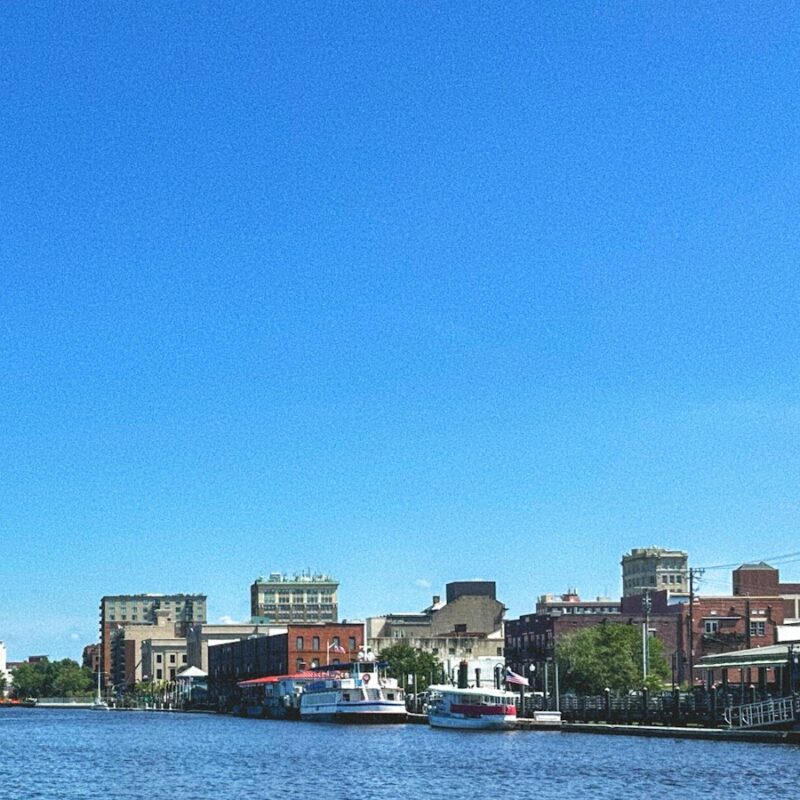
Savannah is known for its historic district laid out around more than 20 garden squares, its riverfront and its nearby beach at Tybee Island. Wilmington has a historic riverfront downtown along the Cape Fear River, and beaches like Wrightsville, Carolina and Kure within about 20 to 30 minutes. Both have lively restaurant scenes and hot, humid summers. Neither is “better.” The right fit depends on your budget, how taxes affect your situation and how you want to spend your weekends.
If you’re weighing Savannah against the Cape Fear coast, I’d love to help you compare specific homes. You can also see how Wilmington stacks up in my Wilmington vs. Charleston and Wilmington vs. Myrtle Beach guides.
Compare Wilmington with other cities
Weighing more than one move? Each of these side-by-side guides uses current, dated sources:
- Wilmington vs. Charleston, SC
- Wilmington vs. Myrtle Beach, SC
- Wilmington vs. Raleigh, NC
- Wilmington vs. Charlotte, NC
- Wilmington vs. the Outer Banks
- Wilmington vs. Virginia Beach, VA
- Wilmington vs. New Bern, NC
Thinking about making the move? Call or text me at 910-983-8963 or visit www.makingilmhome.com
Frequently asked questions
Is Savannah cheaper than Wilmington, NC?
For home prices, yes. In the three months ending August 2026, Redfin put Savannah’s median sale price at about $331,600 vs. about $469,700 in Wilmington. Average rents are similar, about $1,704 in Savannah and $1,675 in Wilmington. Taxes work differently in each state, so compare the total cost for a specific home.
Which has lower taxes, Georgia or North Carolina?
For income tax in 2026, North Carolina’s flat rate is 3.99% and Georgia’s is 4.99%. Georgia offers a retirement income exclusion of up to $35,000 or $65,000 per person depending on age. Sales tax is 7% in both Chatham and New Hanover counties. Property taxes depend heavily on exemptions, so get an estimate for the specific home.
How are property taxes calculated in Savannah, GA?
Georgia taxes homes on 40% of fair market value. Inside Savannah city limits, the combined 2025 county, transit, school and city rates were about 40.5 mills, or roughly $1.62 per $100 of market value before exemptions. Chatham County’s Stephens-Day homestead exemption can freeze an owner-occupied home’s taxable value, which often lowers the bill significantly.
How far is Savannah from Wilmington, NC?
Roughly 300 miles, or about five hours by car.
Do hurricanes hit Savannah?
Yes. Hurricane Matthew in 2016 set the record high water level at the Fort Pulaski tide gauge near Savannah, and Irma in 2017 was the second highest. Tropical Storm Debby caused major rain flooding in Savannah in 2024. Wilmington faces similar coastal risks, so check flood zones in either city.
Tabetha Klein, REALTOR® | Coldwell Banker Sea Coast Advantage · 910-983-8963 · www.makingilmhome.com. Each office is independently owned and operated. Equal Housing Opportunity. Figures reflect sources available as of September 2026 (Redfin city median sale prices, 3 months ending August 2026; Chatham County, City of Savannah and Savannah-Chatham schools 2025 adopted millage rates; Chatham County Board of Assessors; Georgia Department of Revenue and Governor’s office; NC Department of Revenue; New Hanover County and City of Wilmington FY2026–27 tax rates; RentCafe/Yardi average rents; Georgia Department of Labor; BLS via FRED; Savannah/Hilton Head International Airport; WilmingtonBiz; National Weather Service; NOAA; GPB News; Georgia Ports Authority; The Current; City of Savannah 2025 Water Quality Report). The Savannah property tax figure is an estimate calculated from published millage rates before exemptions; 2026 rates were proposed at 2025 levels. Numbers change often. Verify taxes, insurance and flood information for any specific property. This article is general information, not legal, tax or insurance advice.
Sources: Redfin: Savannah housing market · Redfin: Wilmington housing market · Georgia Governor: 2026 tax legislation · Chatham County Board of Assessors: Exemptions · RentCafe: Savannah rents · NCDOI: 2025 rate settlement · FRED: Wilmington unemployment · SAV: Airport statistics · WilmingtonBiz: ILM passenger record · NWS: Hurricane Matthew · GPB: Tropical Storm Debby in Savannah · Georgia Ports Authority: FY2026 volumes · Savannah 2025 Water Quality Report