Moving from Washington, DC to Wilmington, NC usually means a lower purchase price, a lower income tax rate and a smaller property tax bill, traded for higher homeowners insurance and a car-first daily routine. Redfin put the District’s median sale price at about $684,000 in August 2026 versus about $470,000 in Wilmington. The drive is roughly 370 miles, about six hours, and American flies nonstop from DCA year-round.
I’m Tabi, a REALTOR® with Coldwell Banker Sea Coast Advantage in Wilmington. My family compared a lot of coast before choosing Wilmington in 2021, and Washington-area buyers are the single largest group moving here right now: Redfin’s migration data for April through June 2026 ranked the DC metro first among inbound metros to Wilmington. This guide covers the District, Northern Virginia and suburban Maryland, with every number dated and sourced so you can check my math.
The money side, side by side
- Home prices. Redfin’s Washington, DC page shows a median sale price of $684,297 in August 2026, down 0.7% year over year, with a median 57 days on market. Fairfax County, VA ran about $749,000 for the three months ending August 2026 (down 0.8%, 38 days on market). Wilmington’s median was $469,689 in August 2026, up 3.2%, with 56 days on market (Redfin). Suburban Maryland and the District’s own neighborhoods vary widely, so treat these as starting points.
- Property tax. The District taxes Class 1 residential property at $0.85 per $100 of assessed value, and owner-occupants get a $91,950 homestead deduction for tax year 2026 (DC Office of Tax and Revenue). Fairfax County’s FY2026 adopted rate is $1.1225 per $100, and the county reported a mean residential assessment of $794,235, which works out to roughly $8,900 a year (Fairfax County FY2026 Adopted Budget). Montgomery County, MD held its property tax rate flat in the FY2027 budget adopted May 21, 2026, while eliminating the former $692 county income tax offset credit for levy year 2026 (Montgomery County Council and Department of Finance). Inside Wilmington city limits, the FY2026-27 combined rate is 63.75 cents per $100 (30.6 cents county plus 33.15 cents city), which is about $2,990 a year on a $469,689 home; outside city limits in unincorporated New Hanover County it’s 37.85 cents. My 2026 property tax post explains why two nearby homes can pay very different bills.
- State income tax. The District’s 2026 rates run from 4.00% to 10.75% (Tax Foundation). Virginia’s run from 2.00% to 5.75%, with the top rate starting at $17,000 of taxable income. Maryland’s run from 2.00% to 6.50%, plus a county income tax of up to 3.3% (Tax Foundation, 2026). North Carolina’s 2026 rate is a flat 3.99%, and North Carolina does not tax Social Security benefits.
- Sales tax. The District’s general rate is 6.0% through September 30, 2026 and rises to 7.0% on October 1, 2026 (DC OTR). Most of Northern Virginia charges 6%, and Maryland’s rate is 6% (Tax Foundation, 2026). New Hanover County’s rate is 7%.
- Homeowners insurance. This is the line that goes the wrong way. NerdWallet’s May 2026 analysis of a $400,000-dwelling policy put the average at $1,645 a year in the District, $2,265 in Virginia and $2,375 in Maryland, against $3,025 for North Carolina and $2,490 nationally. Published 2026 estimates for Wilmington range from about $3,400 to $7,200 a year, and wind and flood coverage are priced separately near the coast. My homeowners insurance guide shows what drives the spread.
- Rent. RentCafe’s average apartment rent as of August 31, 2026 was $2,447 in Washington, DC (average 746 square feet) versus $1,658 in Wilmington.
- Cost of living index. The C2ER Cost of Living Index, as published by RentCafe in September 2026, puts Washington, DC about 37% above the national average, with housing 102% above. Wilmington sits about 5% below the national average, with housing about 21% below. The full picture is in my cost of living guide.
Getting back and forth
By car, the District to downtown Wilmington is about 370 miles via I-95 and I-40, and I’d plan on roughly six hours without heavy traffic (routing checked September 2026). The slow stretches are usually Fredericksburg to Richmond and the I-95 merge in Petersburg. Add time on summer Fridays and holiday weekends.
By air, Wilmington International Airport (ILM) is about 15 minutes from downtown. Per flyILM’s route list as of September 2026, American Airlines flies nonstop between ILM and Reagan National (DCA) year-round, and Avelo Airlines flies a seasonal nonstop to Baltimore/Washington (BWI). There is no nonstop to Dulles (IAD). For hybrid schedules, the year-round DCA nonstop and the six-hour drive are the two options that make a Washington trip a day or an overnight rather than a project. Amtrak does not serve Wilmington; the nearest station is in Wilson, NC, about two hours away.
What changes day to day
Weather. NOAA’s 1991–2020 normals show Wilmington’s average January high at 57.2°F versus 44.8°F at Reagan National, and July highs nearly identical at 90.0°F versus 89.6°F. Wilmington averages 60.15 inches of rain a year (Washington: 41.82) and 0.9 inches of snow (Washington: 13.7). Summer humidity feels familiar; the winters are what change.
Hurricane season. It runs June 1 through November 30. Storm preparation, evacuation zones and insurance deductibles become part of the calendar. My hurricane risk guide for buyers walks through how to evaluate a specific house.
Driving instead of Metro. Wilmington has a bus system, Wave Transit, but no rail. Most households drive everywhere, and the friction points are the Cape Fear Memorial Bridge to Leland, Market Street and College Road at rush hour, and beach traffic on summer weekends. A 20-minute cross-town drive is common; a 45-minute one is unusual.
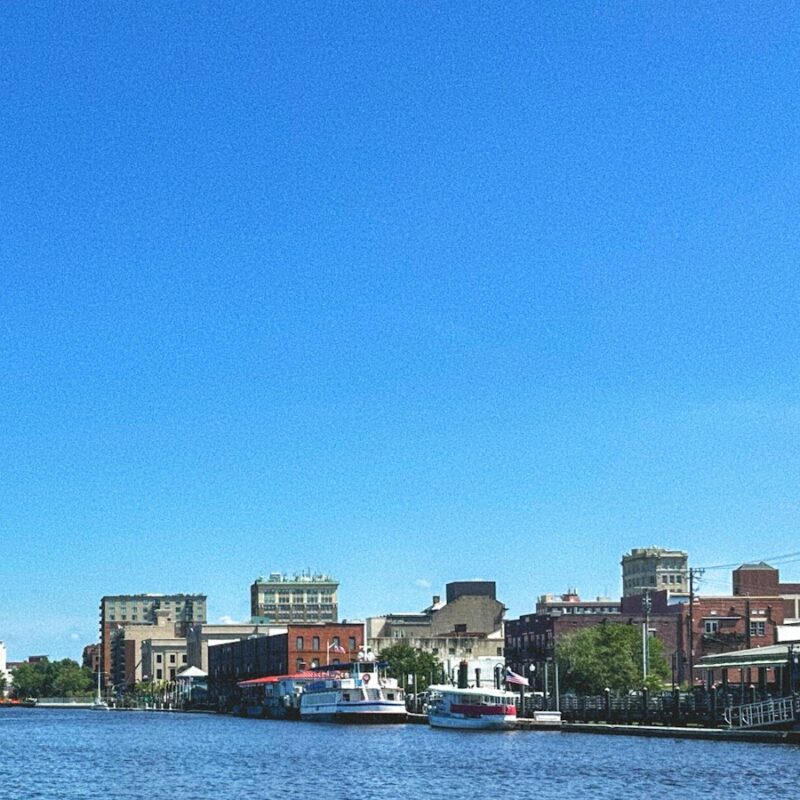
Pace, water and food. Downtown sits on the Cape Fear River with a Riverwalk, and Wrightsville, Carolina and Kure beaches are 20 to 30 minutes from most of the city. Restaurants lean seafood, Southern and casual, with a growing brewery scene, and dinner reservations are easier to get than in the District. Sports means UNCW basketball and the Wilmington Sharks summer baseball team rather than pro teams; the Carolina Hurricanes in Raleigh are about two hours away and the Panthers in Charlotte about three and a half.
Three questions I hear from Washington-area buyers, answered plainly: Is there a real commute culture? Not really; most people live within 20 minutes of work. Is there public transit I can rely on? Wave Transit runs fixed bus routes, but a car is the practical default. Do winters actually feel like winter? Some cold snaps and rare snow, but the January average high is in the upper 50s. If you want the unvarnished list of drawbacks, read my reasons not to move to Wilmington.
Where people from the DC area tend to look
Preference-driven, not a prediction. These are the areas whose attributes most often match what buyers from the District, Northern Virginia and suburban Maryland tell me they want. My best neighborhoods guide covers the full list.
- Downtown Wilmington: the most walkable option, with the Riverwalk, restaurants and historic homes, plus condos and townhomes. Closest to a Capitol Hill or Logan Circle daily rhythm.
- Midtown and UNCW: 1960s to 1990s neighborhoods with mature trees, central to everything, generally lower price points than the beaches.
- Ogden and Mayfaire and Landfall: suburban-style shopping and newer construction, with Landfall’s gated golf-and-marina setting a few minutes from Wrightsville Beach.
- RiverLights and Leland: master-planned new construction, RiverLights on the river inside the city and Leland across the bridge in Brunswick County at a different tax rate.
- Wrightsville Beach and Carolina Beach: island living with water access on both sides, and price and insurance to match. Hampstead and Porters Neck sit north of the city for buyers who want larger lots and Intracoastal access.
The paperwork
- Driver’s license and registration. The NCDMV gives new residents 60 days after establishing residency to get a North Carolina license and register vehicles.
- Vehicle tax. North Carolina’s Tag & Tax Together program collects the annual vehicle property tax with your registration renewal. If you’re coming from Fairfax County or the District, the concept is familiar; the bill is based on the local property tax rate.
- Insurance quotes early. Get homeowners, wind and flood quotes before your due diligence period ends, not after. The spread between two similar houses can be thousands of dollars a year. My buying a home in Wilmington guide explains how the NC due diligence period works.
- Homestead differences. The District’s $91,950 homestead deduction and 10% assessment cap, and Maryland’s Homestead Tax Credit that limits taxable assessment increases to 10% a year, do not carry over. North Carolina has no general homestead exemption; property tax relief here is limited to programs for qualifying elderly, disabled and disabled veteran homeowners.
- Everything else. Utilities, voter registration, schools and pet licensing are collected on my moving to Wilmington resource links page.
Timing your move
Wilmington’s market has slowed in pace more than in price: median days on market reached 56 in August 2026, up from roughly 26 a year earlier, with more listings to choose from (Redfin, via my September 2026 market update). Spring and early summer bring the most new listings; late fall and winter bring fewer, but also less competition. Hurricane season runs June through November, and a closing scheduled during an active storm can be delayed by lenders requiring re-inspection. If you have children, New Hanover County Schools assigns schools by home address, and enrollment requires proof of residency; my school enrollment guide covers the process, and the NC School Report Cards site has the official data for any school.
Still deciding whether Wilmington is the right fit at all? Start with Is Wilmington, NC a good place to live?
Planning a move from the Washington, DC area? Call or text Tabi: 910-983-8963, or send me a note and I’ll set up a search around your commute, budget and flight schedule.
Frequently asked questions
Is Wilmington, NC cheaper than Washington, DC?
For housing and taxes, yes. Redfin’s August 2026 medians were $684,297 in Washington, DC and $469,689 in Wilmington, and the C2ER index (RentCafe, September 2026) puts DC 37% above the national average versus Wilmington 5% below. Homeowners insurance is the exception: NerdWallet’s 2026 average is $1,645 in DC and $3,025 in North Carolina.
How do property taxes compare between Fairfax County and Wilmington?
Fairfax County’s FY2026 rate is $1.1225 per $100, about $8,900 a year on the county’s $794,235 mean residential assessment. Inside Wilmington city limits the FY2026-27 combined rate is 63.75 cents per $100, about $2,990 on the $469,689 median home; unincorporated New Hanover County is 37.85 cents.
Are there nonstop flights from Wilmington to Washington, DC?
Yes. Per flyILM’s September 2026 route list, American Airlines flies nonstop between ILM and Reagan National (DCA) year-round, and Avelo Airlines flies a seasonal nonstop to Baltimore/Washington (BWI). There is no nonstop to Dulles. Driving is about 370 miles, roughly six hours.
What is the income tax difference between DC, Virginia, Maryland and North Carolina?
For 2026, the District’s rates run 4.00% to 10.75%, Virginia’s 2.00% to 5.75%, and Maryland’s 2.00% to 6.50% plus a county tax of up to 3.3% (Tax Foundation). North Carolina charges a flat 3.99% and does not tax Social Security benefits. Deductions differ, so check with a tax professional.
Tabi Klein is a REALTOR® with Coldwell Banker Sea Coast Advantage in Wilmington, NC. Each office is independently owned and operated. Equal Housing Opportunity. Figures above are from the dated sources listed and change over time; verify current rates, taxes and insurance costs for any specific property before you buy. Call or text 910-983-8963 or visit www.makingilmhome.com.
Sources: Redfin Washington, DC housing market (August 2026); Redfin Fairfax County (three months ending August 2026); Redfin Wilmington, NC (August 2026); DC OTR real property tax rates and homestead deduction (tax year 2026); DC OTR sales tax notice; Fairfax County FY2026 Adopted Budget Summary; Montgomery County Department of Finance and County Council FY2027 budget release (May 21, 2026); Tax Foundation 2026 state pages for DC, Virginia and Maryland; NerdWallet average homeowners insurance cost (May 2026); RentCafe Washington, DC rent, RentCafe Wilmington rent and RentCafe cost of living (C2ER) (August–September 2026); flyILM airlines and destinations (September 2026); NOAA 1991–2020 Climate Normals for Reagan National and Wilmington International; NCDMV.