

Wilmington Private Schools: Your Options
If you’re relocating to New Hanover County, public school isn’t the only path, and Wilmington private schools are a real option. Whether you’re looking for a faith-based education, a small independent college-prep environment, or a specific learning approach, the Wilmington area has a range of private schools to consider — and thanks to North Carolina’s voucher program, private tuition is more accessible than it used to be.
Here’s a factual overview of the private-school landscape, what it typically costs as of 2025, and how the state’s Opportunity Scholarship program works.
(New to the area? Start with my companion guide, Wilmington-Area Public Schools: How the System Works, for how the public district is organized — or jump to my guide to high schools in and around Wilmington for public, charter, and independent 9–12 options.)
The private-school landscape
For the 2025–26 school year, New Hanover County is home to roughly 23 private schools serving about 4,850 students. They span a wide range: independent (nonsectarian) college-prep schools, Christian and Catholic schools, a Quaker school, and smaller specialized programs. Some cover PreK through 12th grade; others focus on elementary or high school only.
Because everyone’s priorities are different — faith, class size, academics, athletics, learning support, or commute — the right fit is genuinely personal. This guide is meant to orient you, not to rank or recommend any particular school.
What private school costs in the Wilmington area (2025)
Tuition varies widely by school type and grade level. As of the 2025–26 school year:
- Average private-school tuition in New Hanover County runs around $10,600 per year — a bit below the statewide North Carolina average of roughly $13,000.
- Faith-based schools tend to sit toward the lower end. For example, Coastal Christian High School‘s tuition is around $9,144 per year.
- Independent college-prep schools sit at the higher end. Cape Fear Academy, an independent nonsectarian PreK–12 school, lists 2025–26 tuition ranging from about $18,050 (PreK/Kindergarten) up to roughly $25,600 (grades 9–12).
These are ballpark figures to help you plan. Tuition, fees, and financial-aid options change year to year, so always confirm current numbers directly with each school’s admissions office.
A sampling of area private schools
A non-exhaustive, alphabetical list of private schools in the Wilmington area (listed for reference only, not as an endorsement):
- Cape Fear Academy — independent, nonsectarian, college-prep, PreK–12
- Coastal Christian High School — Christian, high school
- Friends School of Wilmington — Quaker independent school, PreK–8th grade
- Myrtle Grove Christian School — Christian, PreK–12
- St. Mary Catholic School — Catholic, elementary/middle
- Wilmington Christian Academy — Christian, K–12
Grade ranges, programs, and enrollment change, so check each school’s website for current details.
North Carolina is a school-voucher state — here’s how that works
North Carolina funds private-school tuition for families through the Opportunity Scholarship program, administered by the NC State Education Assistance Authority (NCSEAA). Established in 2013 and significantly expanded in recent years, it’s one of the reasons private school is worth a look even if you assumed it was out of reach.
How it works, in plain terms:
- Every North Carolina K–12 student is now eligible to apply, regardless of household income. A 2023 law removed the old income cap starting with the 2024–25 school year, and families whose children already attend private school can apply too.
- The award amount is tied to household income. Lower-income families receive the largest awards; higher-income families receive smaller ones. For the 2025–26 school year, scholarships are worth roughly $3,458 to $7,686 per student, per year, across four income tiers. The lowest tier receives close to what the state spends per public-school student; the top tier receives about 45% of that.
- The money goes toward tuition and fees at a participating (eligible) private school — so you’ll want to confirm a school participates before counting on it.
- Applications run through NCSEAA on set windows (typically opening in late winter/early spring for the following year). Award amounts and funding are set by the state legislature, which funded the program at roughly $625 million for 2025–26.
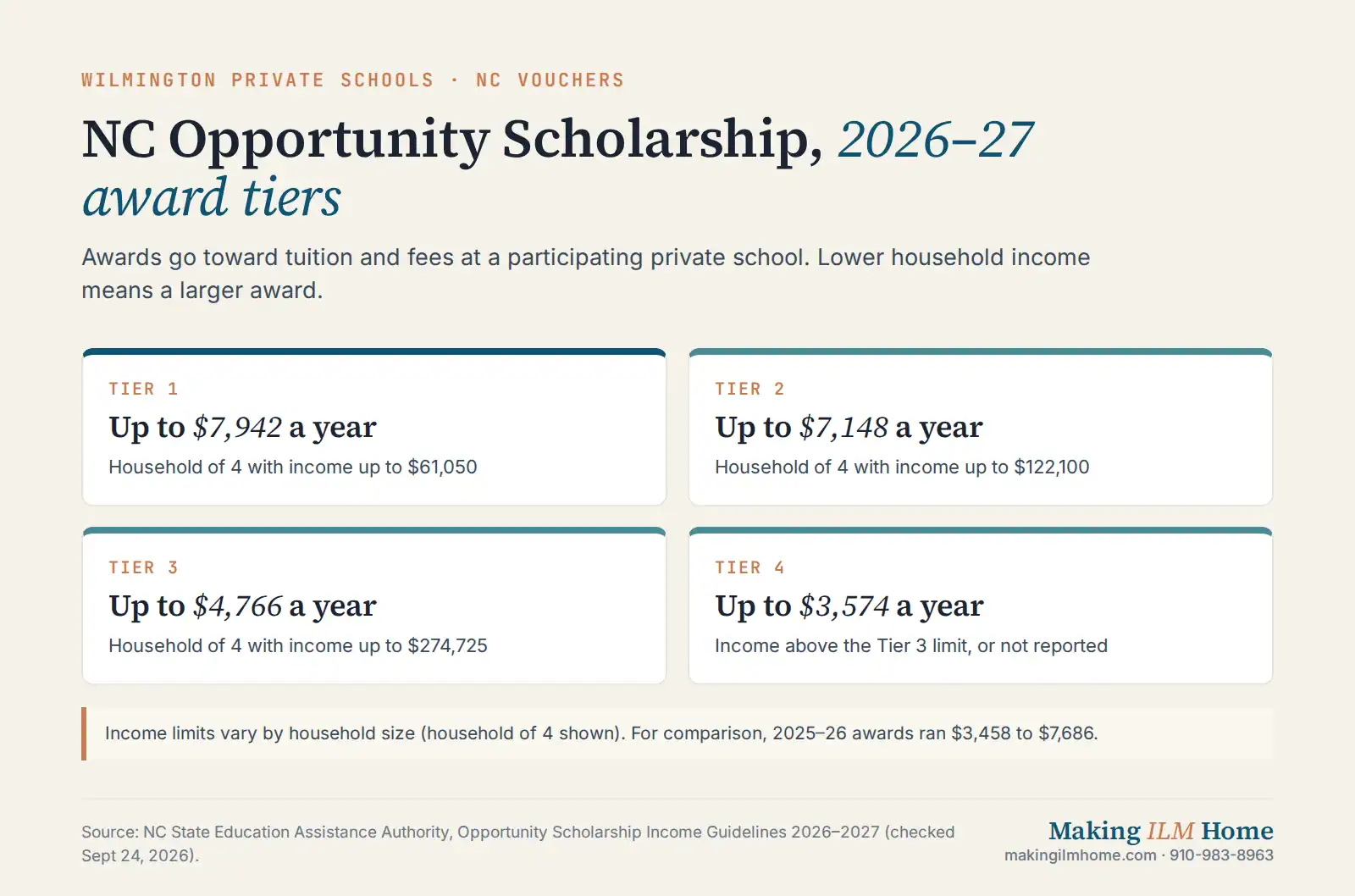
There’s also a separate program, ESA+ (Education Student Accounts), for students with certain disabilities, which can be used for tuition and other approved educational expenses.
Bottom line: if private school is on your radar, it’s worth applying for an Opportunity Scholarship early — awards and deadlines are handled by the state, not the schools.
How to research private schools yourself
Use official and neutral sources rather than relying on any one person’s take:
- NC Opportunity Scholarship & ESA+ (vouchers): k12.ncseaa.edu
- Each school’s own admissions/tuition page — the only reliable source for current costs and deadlines
- NCES Private School Search (federal directory): nces.ed.gov
- PrivateSchoolReview.com for school profiles and tuition estimates (confirm details with each school)
Frequently asked questions
How much does private school cost in Wilmington, NC?
As of the 2025-26 school year, average private-school tuition in New Hanover County runs around $10,600 per year, compared with a North Carolina average of roughly $13,000. Coastal Christian High School’s tuition is around $9,144 per year, and Cape Fear Academy lists 2025-26 tuition from about $18,050 (PreK/Kindergarten) to roughly $25,600 (grades 9-12). Confirm current tuition and fees with each school’s admissions office.
Who is eligible for the NC Opportunity Scholarship?
Every North Carolina K-12 student can apply, regardless of household income. A 2023 law removed the old income cap starting with the 2024-25 school year, and students who already attend private school can apply too.
How much is the NC Opportunity Scholarship worth for 2025-26?
For 2025-26, awards are roughly $3,458 to $7,686 per student, per year, across four income tiers, with lower-income households receiving the largest awards. The money goes toward tuition and fees at a participating private school, so confirm a school participates before counting on it.
How do I apply for an NC Opportunity Scholarship?
Applications run through the NC State Education Assistance Authority (NCSEAA) at k12.ncseaa.edu on set windows, typically opening in late winter or early spring for the following school year. Awards and deadlines are handled by the state, not by the schools.
Where can I find official information on Wilmington-area private schools?
Each school’s own admissions and tuition page is the reliable source for current costs and deadlines. The federal NCES Private School Search at nces.ed.gov lists private schools, and k12.ncseaa.edu covers the Opportunity Scholarship and ESA+ programs.
Let’s talk about your move
If you’re relocating to the Wilmington area and weighing public versus private options, I’m happy to help you check the school assignment, commute and taxes for any address you’re considering so you can make the decision that fits what you need — no pressure, no steering, just local know-how. Planning the whole move? Start with school enrollment, registration and assignment in Wilmington for enrollment steps and deadlines.
Tabi | Making ILM Home REALTOR® • Coldwell Banker Sea Coast Advantage 910-983-8963 | www.makingilmhome.com
Information is provided for general reference only and is current as of July 2026. Tuition, fees, scholarship award amounts, eligibility rules, program funding, and application deadlines are set by individual schools and the State of North Carolina and change over time — always verify directly with each school and with the NC State Education Assistance Authority before making decisions. This information does not constitute a recommendation or endorsement of any school or program. Tabetha Klein, REALTOR®, Coldwell Banker Sea Coast Advantage. Each office is independently owned and operated. Equal Housing Opportunity.